Tampilkan postingan dengan label Academics. Tampilkan semua postingan

Kamis, 09 Oktober 2014

Work!


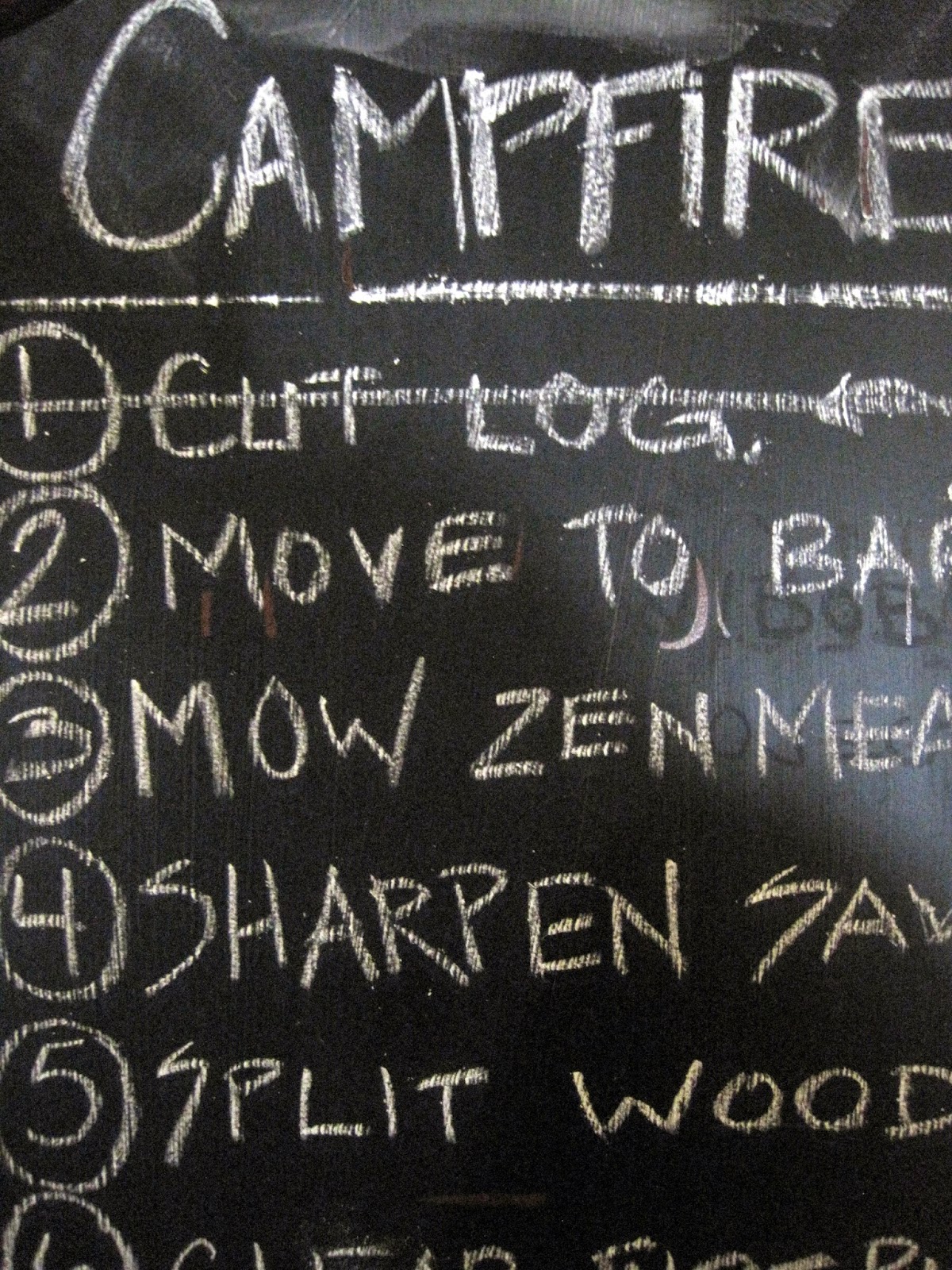
Campfire is coming.

The to-do list is long, and every day I seem to be getting an email requesting information for this or that. Earlier this week, I cut the perfect log for the cross-cut saw competition. Today I kind of ruined that log dragging it to the barn. Idiotically, I did not notice that it was being chipped away by the road. So now the back third of it is a smaller diameter. Alas, it will have to do. What is done is done. And my calves hurt. Many thanks to Bill, Oliver, and Lauren for the help!

Today was a full-on Saginaw day. In addition to the log dragging, I did rounds, attended a Properties Committee meeting, cleaned up the bonfire pit, and mowed down the zen meadow. I'm whipped.

Class use this fall has been extensive. Several ecology classes have been out in the woods, and a few others may be seen floating about the lake. My first year landscape architecture students have made several field trips out here (and will be out again tomorrow). As they research the site for their projects, a lot of interesting photographs and information have become available. One student in particular found some excellent old images at the Bentley Library. So much flannel!

Before.
After
Last weekend I cleared some deadfall from the driveway, and also attended the Native Plant Sale at the botanical gardens. I picked up a hefty load of my favorite perennials to plant around the cabin. My hope is that they will ultimately disperse their seeds throughout the wood. Saginaw, my gift to you.

The big witch hazel by the cabin is already blooming! It is lovely, but much earlier than anticipated.

Spider flowers.
Oh, you pretty.

Selasa, 16 September 2014

Fall, y'all

I love this time of year.

Turtlehead looking fly.
It's like this nebulous thing...post-summer...pre-fall...The days are somewhat chilly, the nights quite a bit chillier. The trees are just barely starting to turn over in color--I've watched the subtle and slow bronzing of canopy across the lake--and yet the fall blooming flowers are out in full. Aster. Goldenrods. Turtlehead. I noticed the buds of the witch hazel starting to form (and am already looking forward to its lovely November exhibition). I could walk around this place in circles for hours and hours and never care about anything else. Sometimes I do just that. Some of you might have noticed this by now.

Fall, yo.
Tomorrow I am giving some students a tour of the forest. They will be doing some research on improving the educational value/experience of the SNRE properties, but particularly this one. Saginaw Forest is the most well-used of SNRE's research plots, being so near to downtown. I don't think that much will happen in the remainder of my time here in terms of big projects, but it's exciting to discuss them nonetheless. I do still continue my desperate "battle for the barn" and volunteer tools. One hinges upon the other. I am persistent but not hopeful.

Give us a wave if you are around the woods. This is a happy time.

Sabtu, 06 September 2014

Activity, activity.

Things amped up around here the last month or so.

"Amped up" by 80-acre forest standards,  I mean.

Between students coming out to do research and classes starting up, bodies have been busy here around the moss house. Some of you may have noticed this weird contraption out on Third Sister.


I refer to it simply as the "robot boat." But really it's an interesting project being tested by a group of engineering students. Their goal is to design a new and improved method of measuring evaporation on the Great Lakes (current measuring tools are land-based, not real-time). Different versions of Robot Boat have come and gone from our waters as they tweak the design (leaking seemed to be a problem).

A more permanent installation has been put in place to monitor the flash floods of Honey Creek, just behind the outhouse.

Classes are going to start using the site soon as well. Soil Ecology, Woody Plants, and even the class I'm the GSI for--the first year landscape architecture studio. I'm really excited to be working with a class taking on a design project out here. Talk about a perfect opportunity for all involved. I've been gearing up for the influx of activity with meetings, clearing honeysuckle/buckthorn, mowing, and collecting tools. This is an exciting fall.

The weather wreaked havoc on tree branches here last night, as I'm sure those of you in Ann Arbor can believe! But I do love this place post storm. It takes my breath away every time.


Enjoy the goldenrod.

Selasa, 07 Mei 2013

Algae Sampling

Field season has begun. Today, I had some students picking up equipment and some others taking a phytoplankton sample.

IMG_5340

Jumat, 14 Desember 2012

Surveying the creek

Last week, as the final part of a class project, there was a student finishing up the survey of the creek bed.

IMG_5146

Selasa, 16 Oktober 2012

SNREds in the forest

Today, Prof. Wiley's wetlands practical class came out to Saginaw Forest to look at the wetlands found on the property. Hopefully, the class will return in future years!

IMG_4353

Sabtu, 18 Agustus 2012

On this date in 1941: The second application of rotenone on Third Sister Lake

Time was that the humane treatment of animals didn't really extend to fish. As part of a bit of background reading to assess the possibility of conducting an updated fish survey of Third Sister Lake, I found only one article on the topic of fish in this lake, and it was published in 1942.

The very first sentence of the introduction reads:
The complete removal of fish from Third Sister Lake was not carried out for the primary purpose of making a fish population analysis but rather as part of a general investigation on the existing relationship between the fish and fish-food organisms in this lake.
The author continues by clinically describing the process:
The destruction of the fish population was accomplished by means of rotenone (Derris root) which was supplemented by netting-and angling during the 3 weeks previous to poisoning. The actual poisoning process and its effect on the fish and other organisms found in the lakes described by the authors elsewhere in this volume.

The first poisoning operation was carried out on May 6, 1941, before the spawning season and before the aquatic vegetation was extensive enough to hamper the recovery of fish ... Because the first poisoning did not kill all the fish, a second application was made on August 18 and 19 when water temperatures were more favorable. Only a very few adult fish were recovered along with many thousand bluegill and pumpkinseed fry. These were not included in the population total. After that time, however no fish were seen in the lake until June, 1942,when a few long-eared sunfish entered the lake, presumably via the outlet during high water. We believe that the poisoning was 100 per cent effective in the removal of fish in August.
In other words, they poisoned the lake and then collected the fish that floated up to the surface. The first time wasn't good enough to clear the lake, and so they did another application, but didn't include those fish in the survey. Oh, and by the way, no fish were seen until the summer of the following year; likely up-migration from the connecting stream.

We are relatively concerned about the presence of 1,4 dioxane in the groundwater, and the spills and their infiltration into the groundwater is cause for concern throughout the area affected, but it is worth noting that the wonderfully lovely looking Third Sister Lake was - at one point - the site for the deliberate complete and utter destruction of all fish (and all invertebrates, as well) in the lake. Of course, unlike 1,4 dioxane which is a very persistent molecule, rotenone loses almost all of its toxicity within one week.

Still, considering that the methodology is one that we wouldn't think of using today when conducting fish surveys, the 1941 survey did a few things, such as provide a good estimate of total fish biomass in Third Sister Lake as well as providing a date certain from when there were absolutely no fish in the lake.

BTW, rotenone continues to be used for fish collection and as a measure of last resort for fish management. Happily, though, rotenone won't be use in Third Sister Lake at any time soon.
Minggu, 24 Juni 2012

Cleared brush & saw raccoons

This morning, we cleared some of the brush that had grown up west of the dock so that we could put one of the small research vessels into Third Sister Lake. I can also now see the end of the dock from the cabin.
IMG_3116

Much of the work was facilitated by the use of the chainsaw, well-sharpened loppers, a hard-tined rake, and two masters' students who will be using the lake to calibrate their equipment for their main summer research sites within the Muskegon River watershed.

Also, when conducting my evening rounds, I heard some grunting and scrabbling in the trees near the frog pond. As I looked up, I saw two masked faces staring back at me, and soon saw a third raccoon clambering up yet another tree. I guess the pickings along the road - the pickings of civilization - are a little bit dried up at present. Maybe they know that the garbage won't be put out until Tuesday night and so are foraging for more "evolutionarily traditional" food down by the frog pond. Hopefully the deer flies aren't getting to them as bad; the buggers were flying all around my head as I did my rounds.

Jumat, 22 Juni 2012

Brief description of Third Sister Lake

Although there have been many studies in Third Sister Lake, although I provided an initial description of Third Sister Lake, and although there have been descriptions of the history of the forest, little on this site has included much discussion of the history of the lake and of the inputs to the lake.

The following is taken from Hammer & Stoermer (1997), and any use of the following description in any publication must provide proper citation of their paper:
Third Sister Lake (4217' N., 8348' W.) is located approximately three miles west of Ann Arbor in the Saginaw Forest of Scio Township, Michigan (Figure 1). This small kettle lake likely formed during the retreat of the Wisconsin glacier, which created a terminal moraine in southern Michigan (Reed, 1902). Mature conifer plantations and hardwood stands of Saginaw Forest shelter Third Sister Lake. Although the lake stratifies in the summer, spring mixing does not occur every year (Lehman & Naumoski, 1986). The present maximum depth is 17.0 m, and the surface area about 3.8 ha. A small intermittent stream enters the lake on the south shore and a single outflow on the southwest shore drains through a small marsh (Figure 1) to the Huron River.

Although Saginaw Forest surrounds Third Sister Lake on a 32 ha tract, significant construction has occurred in the watershed since the 1960s. Agricultural activities originally occupied the entire area east of Saginaw Forest. Currently, this adjacent property is subdivided into several small plots (Wojcik, 1993, personal communication) where industrial and commercial construction has occurred from 1963 to the present (Figure 1). Contamination of Third Sister Lake and local groundwater with 1,4-dioxane was revealed in the 1980s following leakage from an unlined, oxidation lagoon on Gelman Sciences, Inc. property bordering the lake (Brode&Minning, 1988). The most recent project in the adjacent lot, initiated in 1987, included retention pond construction with an outflow that transports stormwater from this nearby property into the inflow stream bed in Saginaw Forest. Ultimately this stormwater reaches Third Sister Lake 300 m downstream. Although erosion barriers were erected in the stream bed on university property, these barriers have since been undercut and subverted by stream flow, creating a gully with steep banks of unconsolidated soil. (Hammer & Stoermer, 1997, pp. 438-439)

Bibliography:
  • Hammer, Brian K.; Stoermer, Eugene F.; (1997). "Diatom-based interpretation of sediment banding in an urbanized lake." Journal of Paleolimnology 17 (4): 437-449. http://hdl.handle.net/2027.42/43079

Plant lists for Saginaw Forest and Stinchfield Woods

Ever been wandering around Saginaw Forest (or Stinchfield Woods) and wonder, "What's that plant over there?"

The School of Natural Resources & Environment, as part of a multi-part project about the properties it manages, has compiled a plant list (along with photos) for Saginaw Forest and Stinchfield Woods, covering all the tree and shrub species (along with a few non-woody plants).

Strangely, it doesn't have an entry for the Murray birch.

Source:

Kamis, 21 Juni 2012

A 1961 description of the plantings

Doing a search for "Saginaw Forest" on the University of Michigan Library's DeepBlue server came up with several university documents about the property, including this one from 1961 that discusses the history and the plantings in the property:

A Guide to Saginaw Forest (1961)

A pdf is available for public download at that site. The document also contains a map of the three near-Ann Arbor properties managed by SNRE (Saginaw Forest, Newcomb Tract, and Stinchfield Woods) as well as an original plantings map of Saginaw Forest.

Kamis, 22 Maret 2012

Spring frog survey done

Frog man, Prof. K. Berven, finished up the spring frog survey last night. This is - not unexpectedly, considering how much warmer this year has been - not surprising, though. However, compared to previous years, the spring 2012 survey seems (at least to me) to have started earlier (I first saw him on March 11, 2012) and lasted for a shorter time than in previous years (which have mentions of his surveys starting between March 13 and March 30 and lasting a few weeks).

Already the sounds of frogs at night has diminished from a deafening cacophony to merely a loud chorus. It seems that this is another price to pay for an inclemently warm March.

Kamis, 15 Maret 2012

Saginaw Forest research

I'm updating the list from August 19, 2010, since I came across another reference, this one to a soil survey conducted in 1964. It's interesting how Google searches are picking up more and more references to studies that have taken place out here. In this case, I think that the Google search turned up the book due to the collaboration that the University of Michigan has with Google - part of the Google Books scanning initiative that's been going on for several years now.

(Remember, too, that there have been several studies on Third Sister Lake.)

SAGINAW FOREST REFERENCES
In chronological order
note: this list is not necessarily exhaustive
compiled by S. Lacy (March 2012)
  • Arnold, JD (1935) �A comparative study of certain species of Marasmius and Collybia in culture� Mycologia 27(4): 388-417
  • Smith, AH (1935) �Studies in the genus Mycenia. I.� American Journal of Botany 22(10): 858-877
  • Blair, WF (1937) �The Burrows and food of the prairie pocket mouse� Journal of Mammalogy, 18(2): 188-191
  • Yeager, LE (1937) �Cone-piling by Michigan red squirrels� Journal of Mammalogy, 18(2), 191-194
  • Hann, HW (1939) �The relation of castration to migration in birds� Bird-Banding 10(3): 122-124
  • Misch, MS (1960) �Heat Regulation in the Northern Blue Jay, Cyanocitta Cristata Bromia Oberholser� Physiological Zoology 33(4): 252-259
  • Ladrach, WE (1964) A Soil Survey of Saginaw Forest, M.For. thesis, University of Michigan, 116pp.
  • Kistler, S, AG Stephenson and WS Benninghoff (1979) �Description of understory development in a tree plantation with a new method of data structuring� Vegetatio 40(3): 185-191
  • Barnes, BV and BC Dancik (1985) "Characteristics and origin of a new birch species, Betula murrayana, from southeastern Michigan" Canadian Journal of Botany 63(2): 223-226
  • Howard, RD and AG Kluge (1985) �Proximate mechanisms of sexual selection in wood frogs� Evolution 39(2): 260-277
  • Olson, CE, Jr and Z Zhu (1985) �Forest species identification with high spectral resolution data� JPL Proceedings of the Airborne Imaging Spectrometer Data Analysis Workshop. Pages 152-157 (SEE N86-11618 02-43); United States
  • Cornell, TJ, KA Berven, and GJ Gamboa (1989) �Kin recognition by tadpoles and froglets of the wood frog Rana sylvatica� Oecologia 78: 312-316
  • Riha, VF and KA Berven (1991) �An analysis of latitudinal variation in the larval development of the wood frog (Rana sylvatica)� Copeia 1991(1): 209-221
  • Berven, KA and RS Boltz (2001) �Interactive effects of leech (Desserobdella picta) infection on wood frog (Rana sylvatica) tadpole fitness traits� Copeia 2001(4): 907-91
  • Kahan, A (2008) Nitrogen and Carbon Biogeochemistry in Soil and Vegetation Along an Indirect Urban-Rural Gradient in Southeastern Michigan. M.S. thesis, University of Michigan.
  • Berven, KA (2009) �Density dependence in the terrestrial stage of wood frogs: Evidence from a 21-year population study� Copeia 2009(2): 328-338

Jumat, 09 Maret 2012

Landscape Architecture students in the forest

Several MLA students came out to the forest this morning to look at the area (mostly around the cabin) for the reason of doing some design options for potentially future build options.

They had several questions about the property, and they will likely be coming out to the forest in the future - singly or in groups. It's exciting to see the property being used for hands-on teaching purposes again.

Minggu, 15 Mei 2011

Studying the black raspberry

For his master's thesis AB will be investigating the fitness of black raspberry (Rubus occidentalis). Apparently, not a lot of modern ecological research has been done on this native plant, and much of what is available is from natural history descriptions that are somewhat contradictory.

IMG_8728

AB's got several plots -- collections of canes that are at least 50 meters apart from each other -- in Saginaw Forest as well as a number in Stinchfield Woods. Hopefully, the work that he does will help give better scientific insight into this plant that is -- at the same time -- both temptingly tasty and annoyingly prolific.

Kamis, 07 April 2011

U-M Limnology class on the waters

The U of M limnology class has returned for another outing of lake measurements on Third Sister Lake.

IMG_8509